


Precision Oncology Decisions
From biopsy slides to outcome-linked tissue intelligence
Aquila Path transforms routine prostate pathology into multidimensional tissue intelligence designed to support clearer biological risk assessment and more informed physician-led decisions.
Routine pathology reveals cancer. Understanding the risk within it is more complex.
The biological patterns associated with disease behavior may extend beyond what conventional grading alone can consistently represent. Aquila Path links patterns within prostate tissue to longitudinal outcomes, helping clinicians interpret how the disease may behave.
Our TruGrade Technology
01 One Score, Total Clarity
TruGrade™ is presented as a biological risk assessment powered by the Aquila Path Foundation Model.
02 Routine Pathology. Extraordinary Potential.
Routine H&E biopsy tissue forms the computational foundation for tissue intelligence.
03 Morphology Becomes Spatial Biology
Aquila Path’s AI analyses how tissue structures and biological features are organized and related, revealing patterns that may be difficult to assess consistently through visual interpretation alone.
04 From Tissue Architecture to Tissue Intelligence
Tissue architecture, spatial relationships, and clinical context converge into a richer representation that captures the complexity of each patient's disease.
05 Biological Risk, Made Interpretable.
Multidimensional evidence contributes to a single TruGrade™ Score designed to support clearer risk interpretation and physician-led decisions.
One unified score from tissue intelligence
Outcome-linked intelligence from routine H&E
TruGrade™ integrates tissue morphology, gland architecture, spatial organization, and clinical context into a single interpretable risk signal designed to support clearer prostate cancer decisions.
Scientific Foundation
Foundation at Scale
Built from the world's largest clinically linked pathology datasets and informed by long-term clinical outcomes, Aquila Path is designed to identify meaningful patterns and outcomes that matter in clinical practice.
From uncertainty to evidence-guided direction
Aquila Path helps care teams move from complex oncology signals to clearer risk understanding, stronger patient conversations, and more structured precision oncology decisions.
The Status Quo
Complex Information. High-Stakes Interpretation.
The TruGrade™ Score
One interpretable score. Greater biological context.
The Clinical Value
More Confidence in Every Conversation
Built for the people who carry each decision forward
Aquila Path translates tissue and clinical evidence into interpretable biological risk insight, helping clinicians assess disease and helping patients engage more meaningfully in the decisions that follow.
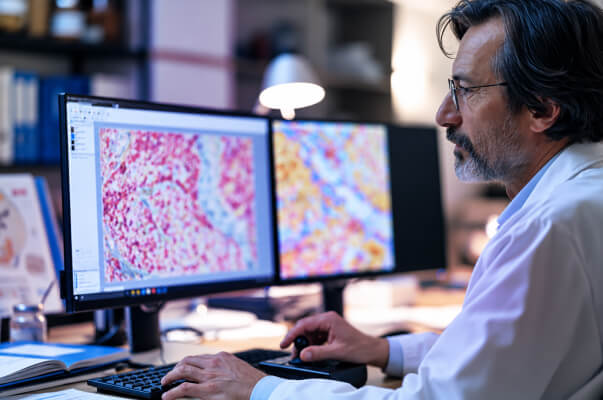
Greater biological context at the point of judgment
Aquila Path complements conventional pathology with an interpretable view of biological risk, strengthening prognosis discussions, patient communication, and physician-led care planning.
Understand the TruGrade™ ScoreMore insight for the conversation ahead
Aquila Path gives your doctor additional insight into the biology of your disease, helping support more meaningful conversations about risk, prognosis, and the options ahead.
Explore Patient Guidance